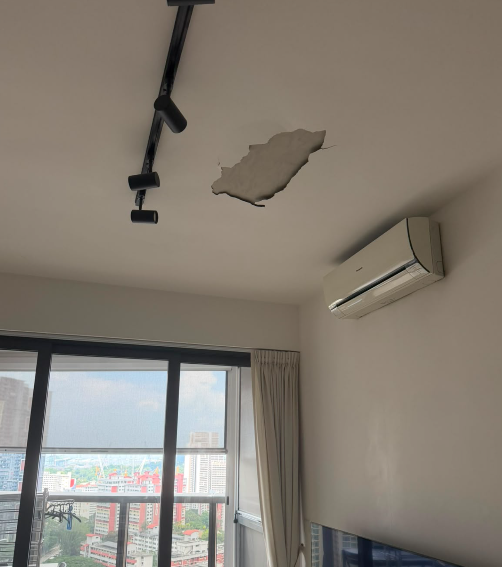
Debonded ceiling plaster occurs when the plaster loses adhesion to the concrete ceiling and becomes hollow, cracked, bulging or loose. Cracks in the concrete ceiling may have different causes, including shrinkage, movement, water leakage or concrete deterioration. The correct repair is to identify the cause, remove unstable material, repair the substrate and reinstate the ceiling finish—not simply patch over the crack.

Overview
- Debonded plaster means the plaster layer has separated from the concrete substrate. Hollow sounds, bulging and loose pieces are common warning signs.
- Concrete ceiling cracks can range from superficial hairline cracks to defects associated with water leakage, movement or concrete deterioration.
- Water leakage must be resolved first. ( if any) Painting or plastering over a leaking ceiling usually results in recurring stains, peeling and debonding.
- Loose or bulging plaster should not simply be painted over because the underlying material may continue to detach.
- Best solution: inspect → identify cause → remove defective material → repair substrate → reinstate suitable finish → monitor.
“The Ceiling Is Cracking Again…” — A Singapore Homeowner Story
You just finished painting your living room.
Everything looks fresh.
Then, three months later:
Crack.
A small line appears on the ceiling.
You ignore it.
Then the paint starts bubbling.
A few weeks later, you tap the ceiling and hear:
“Tok tok tok.”
That hollow sound is when many homeowners realise something is not quite right.
The problem may not be the paint.
It may not even be the visible crack.
The plaster underneath could have debonded from the concrete ceiling.
And if the concrete itself is cracking, there may be a completely different underlying issue.
This is why ceiling repair in Singapore should not always begin with a tub of filler and a paintbrush.
Why Does Ceiling Plaster Debond in Singapore?
Singapore’s hot, humid and wet tropical environment creates challenging conditions for building finishes.
Buildings are also constantly exposed to:
- Humidity
- Temperature changes
- Water leakage
- Condensation
- Concrete movement
- Building settlement
- Age-related deterioration
- Poor previous repairs
- Incompatible repair materials
- Repeated painting and patching
Over time, the bond between plaster and the concrete substrate can weaken.
The result is what contractors commonly describe as:
Debonded plaster.
In simple terms:
The plaster is still physically there, but it is no longer properly attached to the ceiling.
That is why painting the surface does not solve the problem.
Debond Plaster Ceiling vs Cracked Concrete Ceiling
These two defects are often confused.
They are not necessarily the same thing.
A. Debonded Ceiling Plaster
The concrete structure may still be sound, but the plaster or skim coat has lost adhesion.
Typical symptoms:
- Hollow sound when tapped
- Blistering
- Bulging plaster
- Peeling paint
- Hairline cracks across plaster
- Localised loose areas
- Plaster falling from the ceiling
- Repeated cracking after repainting
In this situation, the defective plaster normally needs to be removed before reinstatement.
B. Cracked Concrete Ceiling
This is more important to investigate.
A crack may be:
- Superficial
- Shrinkage-related
- Related to movement
- Caused by water ingress
- Associated with concrete deterioration
- Associated with reinforcement corrosion
- Related to previous alteration or damage
Not every crack means the building is structurally unsafe.
But not every crack should be dismissed as “normal settlement” either.
The pattern, width, location, depth and progression matter.

Common Symptoms You Should Not Ignore
1. Hollow ceiling
Tap the surface lightly with a suitable tool.
A solid area normally produces a relatively firm sound.
A debonded section can produce a noticeably hollow sound.
This is one reason contractors sometimes carry out a tap test during inspection.
2. Bulging plaster
A section of plaster appears swollen or uneven.
This is more concerning than a simple hairline paint crack because the plaster may have lost adhesion.
3. Peeling paint
Peeling paint may be caused by:
- Moisture
- Poor surface preparation
- Old coating
- Alkalinity
- Debonded plaster
- Water leakage
Simply repainting can hide the symptom temporarily without fixing the cause.
4. Brown or yellow stains
Ceiling stains are often associated with moisture.
In an HDB flat, for example, a ceiling leak can originate from the unit above, particularly around wet areas such as bathrooms and toilets.
HDB notes that ceiling leaks can damage electrical items and contribute to mould growth, and recommends addressing leaks promptly.
5. Concrete exposed underneath
If plaster has fallen away and concrete is exposed, inspect the area carefully.
Look for:
- Cracking
- Rust staining
- Exposed reinforcement
- Dampness
- Hollow surrounding areas
- Crumbling concrete
This is no longer simply a painting problem.
Why Does Concrete Ceiling Crack?
There is no single answer.
A competent inspection should consider the location and characteristics of the crack.
Common possibilities include:
Shrinkage cracks
Fine cracks can develop as cementitious materials dry and shrink.
These may be superficial.
Building movement
Buildings experience movement from temperature changes, structural loading and other environmental effects.
Water-related deterioration
Persistent moisture can contribute to deterioration of finishes and, in some circumstances, concrete and reinforcement.
Reinforcement corrosion
When reinforcement corrodes, the corrosion products can expand and exert pressure on surrounding concrete.
This can eventually cause:
- Cracking
- Delamination
- Spalling
- Concrete breaking away
Previous repair failure
Sometimes the original problem was repaired incorrectly.
For example:
Crack → filler → paint → crack returns.
The crack returning does not necessarily mean the filler was “bad”.
The underlying movement or moisture source may simply still exist.
What 9reno Commonly Finds On Site
After years of dealing with Singapore property repairs, one pattern appears again and again:
The visible defect is often smaller than the actual defective area.
A homeowner may point to a 300 mm crack.
But after tapping the surrounding ceiling, the hollow area may extend much further.
Another common situation:
“We already painted this ceiling twice.”
Then we inspect it.
The paint is not the real problem.
The plaster underneath is loose.
Another classic:
“The crack is only a hairline crack.”
Sometimes yes.
But if the crack is accompanied by water staining, hollow plaster or recurring deterioration, it deserves a closer look.
Realistic Homeowner Experiences
Experience 1 — “I thought it was only paint.”
A homeowner noticed a small ceiling crack and repainted it.
The crack returned.
A second coat was applied.
It returned again.
The eventual inspection found loose plaster around the crack.
Lesson: repeated repainting does not repair debonded plaster.
Experience 2 — “The ceiling sounded hollow.”
Another homeowner noticed that a section of ceiling sounded different when tapped.
There was no dramatic crack.
However, the plaster had separated from the substrate.
Lesson: a ceiling defect does not always look serious from below.
Experience 3 — Water stain after renovation
A newly painted ceiling developed a yellowish stain.
The temptation is to repaint.
But if moisture is still entering the ceiling, the stain can return.
Lesson: solve the water source before repairing the finish.
Hidden Risks of Delaying Ceiling Repair
A small ceiling defect does not automatically mean disaster.
But ignoring a deteriorating ceiling indefinitely is not good maintenance practice.
Potential risks include:
Falling plaster
Loose overhead material can become a safety hazard.
Water damage
Persistent leakage can damage finishes and potentially affect electrical components.
Mould growth
Damp areas can create conditions favourable for mould.
Concrete deterioration
Where concrete deterioration is present, continued exposure to moisture and environmental conditions can worsen the defect.
Increasing repair costs
A small localised repair can become a much larger repair if the underlying problem continues.
Repeated painting expenses
This is the classic:
Repair → paint → crack → repaint → crack again.
You are paying repeatedly without fixing the root cause.
How Professionals Repair Debonded Ceiling Plaster
A proper repair normally follows a sequence.
Step 1 — Inspect the ceiling
Check:
- Crack pattern
- Plaster condition
- Hollow areas
- Water staining
- Moisture
- Concrete condition
- Previous repair areas
Step 2 — Identify the cause
Ask:
Why did it happen?
Possible answers include:
- Moisture
- Age
- Poor adhesion
- Movement
- Previous repair
- Concrete deterioration
Step 3 — Remove loose material
Loose and debonded plaster should not simply be covered.
The defective material is removed until a sound substrate is reached.
This step is messy.
But skipping it is often worse.
Step 4 — Repair the substrate
Depending on the condition, the substrate may require:
- Cleaning
- Crack treatment
- Concrete repair
- Anti-corrosion treatment where appropriate
- Repair mortar
- Bonding treatment
The exact repair depends on what is found.
Step 5 — Reinstate the ceiling finish
Once the substrate has been properly repaired, the ceiling finish can be reinstated.
This may involve:
- Skim coating
- Plaster repair
- Fine surface levelling
- Sanding
- Primer
- Final paint
Step 6 — Monitor
If the defect is associated with movement or moisture, monitoring may be necessary.
A good repair is not simply:
“Looks nice today.”
It should also make sense technically.
13. Singapore Ceiling Repair Cost Guide
Prices vary considerably depending on access, ceiling height, defect size, preparation, moisture problems and finishing requirements.
The following is a general Singapore budgeting guide, not a fixed quotation.
| Repair Method | Typical Budget | Suitable For | Difficulty | Value |
|---|---|---|---|---|
| DIY patch & paint | $30–$150 | Very minor cosmetic defects | Low–Medium | ★★ |
| Localised professional repair | $250–$600+ | Small cracks / local debonding | Medium | ★★★★ |
| Larger plaster removal & reinstatement | $500–$1,500+ | Multiple hollow areas | Medium–High | ★★★★ |
| Concrete repair + finishing | $600–$2,000+ | Concrete deterioration | High | ★★★★★ |
| Major ceiling replacement/repair | $1,500–$4,000+ | Extensive deterioration | High | ★★★ |
| Investigation + specialised repair | Varies | Recurring / complex defects | High | ★★★★★ |
Important: these are indicative ranges only. Actual pricing should be based on site inspection.
For small jobs, mobilisation, protection, access equipment and finishing work can make up a significant portion of the cost.
Repair Method Comparison
| Method | Cost | Lifespan | Appearance | Durability | Downtime | Recommendation |
| DIY filler | $ | Low–Medium | Good initially | Low | Low | Minor cosmetic only |
| Repaint only | $ | Low | Excellent initially | Low if defect remains | Low | Usually not recommended |
| Local plaster repair | $$ | Medium–High | Very good | Good | Low | Good for local defects |
| Remove & reinstate debonded plaster | $$–$$$ | High | Excellent | High | Medium | Recommended |
| Concrete repair | $$$ | High | Excellent after finishing | High | Medium | Recommended when required |
| Full ceiling replacement | $$$$ | High | Excellent | High | High | Only when justified |
Should You DIY?
For a tiny cosmetic hairline crack on a stable, dry ceiling, a competent homeowner may be able to carry out minor patching.
But DIY becomes risky when you see:
- Bulging plaster
- Large cracks
- Repeated cracking
- Water stains
- Dampness
- Falling plaster
- Exposed reinforcement
- Rust staining
- Extensive hollow areas
The problem with ceiling defects is simple:
You are working underneath the defect.
Loose material overhead deserves caution.
Expert Recommendation by Property Type
HDB
For HDB flats, do not assume every ceiling repair is simply a cosmetic renovation.
HDB states that homeowners are responsible for ensuring renovation works comply with its requirements, and some works require permits or specific contractors.
If the issue involves a ceiling leak, determine whether the source is from the unit above or common property.
HDB specifically provides guidance for ceiling leaks and explains that responsibilities can differ depending on the source.
Condo
Check the MCST’s renovation and maintenance requirements before carrying out noisy, hacking or structural-related works.
For recurring water ingress, determine whether the problem originates from the individual unit or common property.
Landed Property
Landed homes can have larger ceiling spans, roof-related water ingress and more extensive renovation histories.
Recurring cracks deserve proper investigation rather than repeated cosmetic patching.
Rental Property
For landlords, early repair is usually more economical.
A tenant may report:
“Small crack only.”
Six months later:
“Part of ceiling dropped.”
Do not wait for the second message.
Property Investors
Before selling or renting a property, visible ceiling defects can affect buyer confidence.
A properly documented repair can also demonstrate that the defect was addressed rather than hidden.
Singapore-Specific Considerations
Singapore’s environment is unforgiving to poorly maintained building finishes.
Humidity
High humidity can affect coatings and moisture-sensitive materials.
Heavy rain
Water ingress can expose weaknesses in roof, façade or waterproofing systems.
Condensation
Air-conditioned interiors combined with warm humid conditions can contribute to condensation under certain circumstances.
Ageing buildings
Older finishes may have undergone multiple cycles of patching and repainting.
Coastal exposure
For properties exposed to marine environments, moisture and chloride exposure can contribute to corrosion-related deterioration of reinforced concrete where protective conditions are compromised.
HDB requirements
HDB renovation rules are intended to protect the structural integrity of flats. HDB’s current renovation guidance specifically directs homeowners to building-work requirements and identifies structural alterations such as hacking reinforced concrete structural elements as prohibited works in applicable HDB guidelines.
Do not hack, drill or modify structural concrete simply because a crack is visible.
If structural work may be involved, obtain the appropriate professional assessment and approvals.
What About Ceiling Leaks?
This deserves special attention.
If your ceiling has:
- Brown stains
- Damp patches
- Bubbling paint
- Mould
- Peeling plaster
- Repeated cracking
do not immediately assume the plaster is the root cause.
Water may be entering from:
- Upstairs bathroom
- Toilet waterproofing
- Floor trap
- Pipework
- Roof
- External wall
- Air-conditioning drainage
- Plumbing connection
HDB explains that ceiling leaks in flats can occur when water passes through the concrete floor slab, particularly where waterproofing membranes and screeds have deteriorated.
Repair the water source first. Then repair the ceiling.
Knowledge Box
What is debonded ceiling plaster?
It is plaster that has lost adhesion to the concrete substrate beneath it, resulting in hollow, loose, cracked or bulging areas.
Why does ceiling plaster debond?
Common causes include moisture, poor adhesion, ageing, movement, incompatible materials and previous poor-quality repairs.
Can DIY fix it?
Minor cosmetic cracks may be DIY-friendly, but loose, hollow, bulging or water-damaged plaster should be professionally assessed.
How much does ceiling repair cost in Singapore?
Small professional repairs may start from a few hundred dollars, while extensive plaster or concrete repair can cost over $1,000 depending on access, area and severity.
How long does ceiling repair take?
A small localised repair may take one working day for the physical repair, but drying and curing time can extend the overall process.
How long will the repair last?
A properly repaired and dry ceiling can last for many years. Longevity depends heavily on whether the original cause—particularly water leakage or movement—has been resolved.
What is the best long-term solution?
Identify the cause first, remove defective material, repair the substrate and reinstate the finish properly.
Should cracked concrete be painted over?
No. Painting may hide the crack temporarily but does not establish why the concrete cracked.
Is a ceiling crack dangerous?
Not necessarily. Some cracks are superficial, but cracks accompanied by movement, water damage, concrete deterioration, exposed reinforcement or falling material should be assessed.
Should I repair or replace the entire ceiling?
Not automatically. If the defect is localised, targeted repair is often more economical. Extensive or unstable areas may justify larger-scale reinstatement.
People Also Ask — Singapore
1. Why is my ceiling plaster falling off?
The plaster may have lost adhesion because of moisture, ageing, movement or poor previous workmanship.
2. How do I know if ceiling plaster is debonded?
Hollow sounds, bulging, cracking and loose sections are common indicators.
3. Can I just repaint a cracked ceiling?
Only if the defect is genuinely cosmetic and stable. Repainting does not repair loose plaster or structural concrete defects.
4. Is a hairline ceiling crack serious?
Many hairline cracks are superficial, but recurring or widening cracks should be investigated.
5. Why does my ceiling crack after repainting?
The paint may be revealing an underlying plaster crack, movement or moisture problem rather than causing the defect.
6. How much does ceiling plaster repair cost in Singapore?
Minor repairs can cost a few hundred dollars, while larger repairs may reach $1,000–$2,000 or more.
7. Can water leakage cause ceiling cracks?
Yes. Persistent moisture can damage finishes and contribute to deterioration.
8. Can I plaster over an existing ceiling crack?
It is better to determine the cause first. Otherwise, the crack may return.
9. What should I do if ceiling plaster is bulging?
Keep people away from the affected area and arrange an inspection. Do not simply paint over the bulge.
10. How do professionals repair cracked concrete ceilings?
They first determine the nature and cause of the crack, then carry out the appropriate substrate or concrete repair before reinstating the finish.
Related 9reno Services
- Ceiling Repair Singapore — for general ceiling defects and plaster repairs
- Wall Crack Repair Singapore — for wall cracks and surface deterioration
- Waterproofing Repair Singapore — for moisture-related ceiling problems
- Tile Repair Singapore — for hollow, cracked or damaged tiles
- Bathtub Repair & Resurfacing Singapore — for bathroom-related defects
- Window Frame Repair & Spray Painting Singapore — for ageing aluminium window frames
- Window Spray Painting Singapore — for complete window-frame restoration
- Reinstatement Contractor Singapore — for property handover and restoration works
- Bathtub repair Singapore
- Tile repair Singapore
- Wall and ceiling repair Singapore
- Window frame repair Singapore (for moisture-related issues)
The 9reno Approach: Don’t Just Make the Ceiling Look Good
This is probably the most important point.
A ceiling repair should not be judged only by how good it looks immediately after painting.
A professional repair should answer four questions:
1. What caused the defect?
2. How much material is actually affected?
3. Has the defective material been properly removed?
4. Has the underlying problem been resolved?
If the answer to those questions is yes, then the final plastering and painting becomes the easy part.
If not, you may simply be putting a beautiful coat of paint over a problem waiting to come back.
When Should You Call a Professional?
Arrange an inspection if you notice:
- Ceiling plaster falling
- Bulging ceiling
- Extensive hollow areas
- Repeated cracks
- Widening cracks
- Water stains
- Persistent dampness
- Mould
- Rust staining
- Exposed reinforcement
- Crumbling concrete
- Cracks appearing around beams or structural elements
- A defect that keeps returning after repair
For significant structural concerns, a specialist contractor may need to recommend assessment by an appropriately qualified professional.
BCA notes that buildings require regular maintenance to remain structurally safe and that structural defects can arise from deterioration, wear and tear, overloading and poor maintenance.
Don’t Wait for the Ceiling to Drop
Most homeowners don’t call a contractor when they see the first tiny crack.
They call when:
The crack gets bigger.
Or:
The plaster starts falling.
Or:
The newly painted ceiling becomes stained again.
By then, the repair can be more complicated.
If your ceiling has debonded plaster, hollow areas, recurring cracks, water stains or damaged concrete, 9reno can inspect the condition and recommend the appropriate repair approach.
We work with homeowners, landlords, tenants, property investors and property managers across Singapore.
Need your ceiling checked?
Send 9reno photos or a short video on WhatsApp.
Show us:
- The full ceiling
- A close-up of the crack
- Any water stain or peeling area
- The surrounding ceiling
- A short video showing the affected area
We can then advise whether it looks like a simple cosmetic repair, debonded plaster, moisture-related damage or something that deserves further investigation.
Don’t just paint over the problem. Find out why it happened first.
9reno — Repair it properly. Restore it properly.
Article Tags
debond plaster ceiling, cracked concrete ceiling, ceiling repair Singapore, ceiling plaster repair Singapore, ceiling crack repair, concrete ceiling repair, ceiling leak Singapore, plaster repair Singapore, HDB ceiling repair, condo ceiling repair, ceiling plaster falling off, hollow ceiling plaster, concrete crack repair, ceiling maintenance Singapore, water damaged ceiling, spalling concrete Singapore, property maintenance Singapore, renovation repair Singapore
Final Expert Takeaway
Debonded plaster and cracked concrete are not automatically the same problem.
That distinction matters.
If only the plaster has lost adhesion, the solution may be relatively straightforward: remove the defective material, prepare the concrete substrate, reinstate the plaster system and repaint.
If the concrete itself is cracked, deteriorating, wet or showing signs of reinforcement corrosion, the repair strategy changes.
And if water is involved, fix the water source before repairing the ceiling finish.
The biggest mistake is treating every ceiling defect as a painting job.
A good ceiling repair does not merely make the defect disappear. It identifies why the defect happened and addresses the underlying problem.
Leave a Reply